
Network cabling is the backbone of every high-performing wireless environment, and that relationship matters more now than it ever has. As commercial buildings across Denver, Fort Collins, Boulder, Thornton, Arvada, and surrounding areas pack in more wireless devices, more users, and more bandwidth-hungry applications, the physical infrastructure underneath it all has to keep pace. If the cabling isn’t up to the job, no amount of premium access points or sophisticated wireless controllers will save the experience.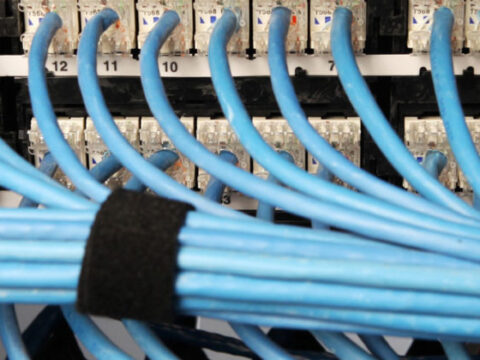
Why Wireless Performance Starts at the Cable
It’s a common misconception that going wireless means the physical layer stops mattering. In reality, the opposite is true. Every wireless access point has to connect back to the network through a physical cable, and in a high-density environment, those connections carry enormous loads. A single access point serving dozens of simultaneous users in a conference center, school, or financial institution is only as capable as the cable feeding it.
In modern commercial deployments, access points are increasingly powered and connected through Power over Ethernet, or PoE. That means the cabling does double duty: it delivers both data and electrical power. Older or lower-grade cabling may not support the power budgets that today’s 802.11ax (Wi-Fi 6) and Wi-Fi 6E access points require, and the result is throttled performance or devices that simply won’t power on correctly. Getting the cable right from the start avoids those headaches entirely.
High-Density Environments Have Different Demands
A standard small office and a high-density commercial environment are not the same problem. Schools, data centers, government buildings, and corporate campuses in the Denver metro and along the Front Range regularly deal with hundreds or even thousands of devices connecting at once. In those settings, the cabling infrastructure has to be designed with that density in mind, not retrofitted after the fact.
This means planning for shorter cable runs where possible, using the right cable category for the application, and making sure pathways, conduit, and patch panels are organized in a way that allows the network to grow without a complete overhaul. A well-structured cabling system also makes troubleshooting dramatically faster. When something goes wrong in a high-density environment, every hour of downtime has real consequences. Clean, labeled, properly documented cabling cuts diagnostic time considerably.
Cable Category and Placement Both Matter
Choosing the right cable category is one piece of the puzzle. Running that cable correctly is another. Even a high-grade cable installed with poor practices, sharp bends, excessive tension, or improper terminations will underperform. In environments where access points are ceiling-mounted and runs pass through drop ceilings, mechanical spaces, and fire-rated walls, installation quality makes a measurable difference in signal integrity and long-term reliability.
We’ve been doing structured cabling installations for close to 30 years, working in everything from small commercial suites in Arvada and Thornton to large enterprise campuses in downtown Denver and beyond. That experience shapes how we approach each project: with attention to the specific demands of the space, not a one-size-fits-all cable pull.
Planning Wireless and Cabling Together
The most efficient installations happen when the wireless design and the cabling design are considered together from the beginning. Wireless site surveys tell you where access points should go and how many you’ll need. That information directly informs where cable drops are needed, how many ports each location requires, and what kind of switching infrastructure will support the load. When those two conversations happen in silos, buildings end up with access points in the wrong places or cabling that wasn’t run to support future growth.
We work with clients in Boulder, Fort Collins, and throughout Colorado’s Front Range and Mountain Communities to integrate that planning process. Whether the project is a new build, a renovation, or an upgrade to an existing network, we look at the full picture before pulling a single cable.
Fiber’s Role in High-Density Buildings
In larger commercial buildings, fiber optic cabling often plays a key role in the backbone connecting network closets or equipment rooms. Fiber handles the high-bandwidth aggregation points where data from dozens or hundreds of access points converges, and it does so without the distance limitations that copper cabling carries. Pairing a fiber backbone with well-run copper horizontal cabling to each access point gives high-density environments the capacity and resilience they need to handle today’s demands and tomorrow’s growth.
Getting It Right the First Time
Structured cabling isn’t glamorous, but it is foundational. A high-density wireless network is only as strong as the infrastructure supporting it, and in commercial environments where downtime and poor connectivity have real costs, that foundation deserves serious attention. We take pride in enterprise-level installations that are built to last, planned carefully, and executed cleanly.
If you’re planning a wireless upgrade, a new construction project, or a cabling refresh in the Denver area or anywhere along the Front Range, we’d love to talk through what you’re working with. Give us a call or drop us an email and we’ll be happy to help you figure out the right approach for your building.